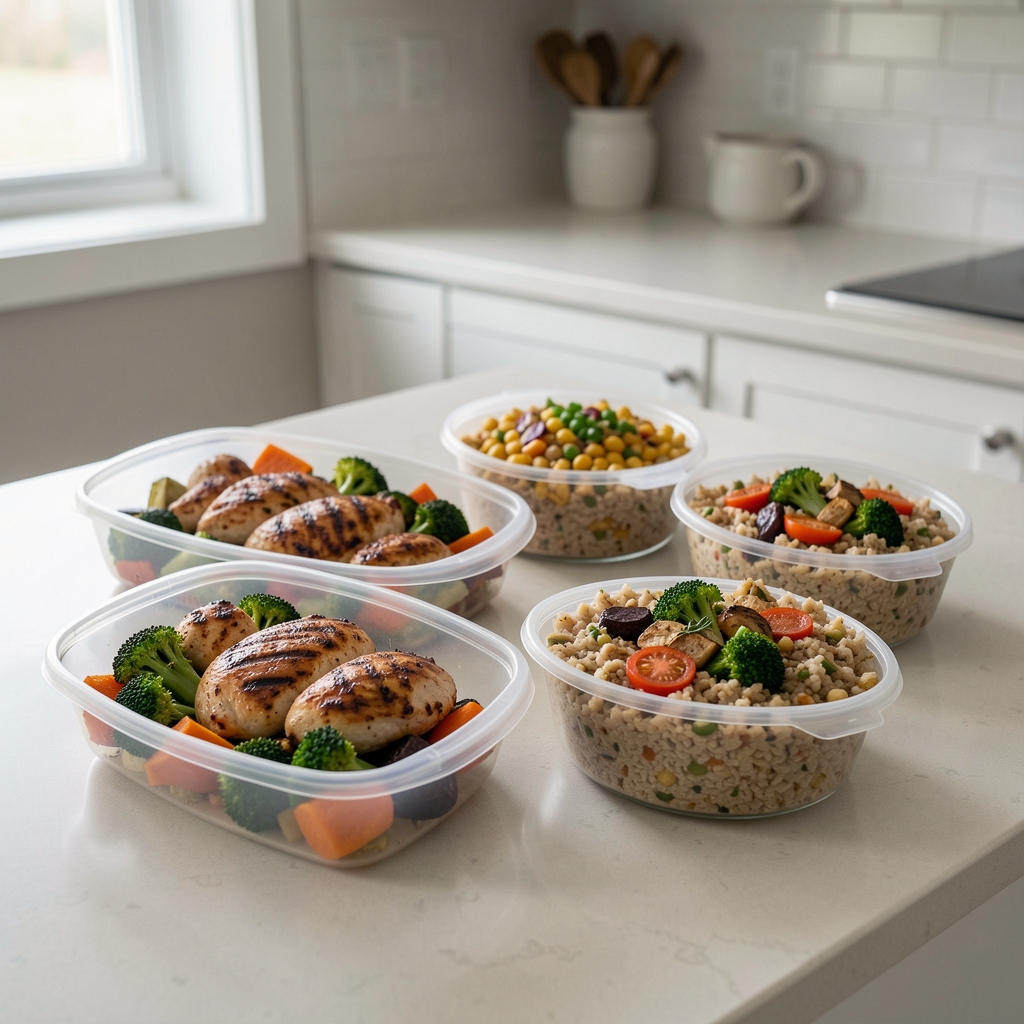
Sunday afternoons carry a particular weight in the weekly structure of a man who eats with intention. By four in the afternoon, with the working week not yet begun, there is a window — two hours at most — in which the nutritional character of the next five days can be largely determined. What happens in that window, or does not happen, shapes what is available at seven in the morning and six in the evening when the body is demanding and the mind is least interested in deciding.
Meal preparation, in this context, is not a diet. It is not a performance of restraint. It is simply a form of advance planning — the same logic that leads a man to lay out his clothes the evening before, applied to the question of what will enter his body across the working week. The benefits are not primarily nutritional. They are logistical: when the food is already made, the decision is already made.
The Problem of the Unconsidered Meal
The unconsidered meal has a consistent profile. It is chosen in a state of hunger, under time pressure, with insufficient information about what options are available. Under these conditions, the choices made tend toward convenience over composition: highly processed foods, meals with low protein and high refined carbohydrate content, foods purchased rather than prepared.
This is not a moral observation. Hunger is a powerful physiological state, and the food environment in most cities is structured to make low-quality choices the most accessible. A man who has not prepared his food in advance is not failing in discipline. He is encountering a structural problem — one that requires a structural solution rather than additional willpower applied at the moment of maximum inconvenience.
The structural solution is preparation. A meal that exists — already portioned, already made — removes the unconsidered meal from the available options. It does not require self-control at six in the evening. It required planning at four on Sunday.
Protein as the Anchor
Among the various nutritional variables relevant to men who train and maintain an active lifestyle, protein occupies a central position. Its role in supporting muscle maintenance, managing satiety, and sustaining body composition across a training cycle is documented across a broad range of published research in sports nutrition. The relevant question for meal preparation is not whether protein matters — that is settled — but how to ensure consistent intake without daily effort.
The answer is batch preparation of a primary protein source. The specific source matters less than the habit. Grilled chicken breast prepared in volume on a Sunday. A quantity of hard-boiled eggs that will last three days. Slow-cooked lean meat divided across several containers. Fish fillets oven-baked and cooled for the week ahead. The protein is available when needed; the decision has been made.
Around this anchor, the structure of the week's meals assembles itself with relative ease. Whole grains cooked in advance. Roasted vegetables. A range of leafy greens that travel well. The individual meal is then assembled — not cooked — in three to five minutes: protein, grain, vegetable, dressing. The cognitive overhead is negligible because the components already exist.
"The Sunday afternoon in the kitchen is not time spent cooking. It is time spent purchasing the freedom to not think about food for five days."
Whole Foods and the Composition of the Plate
The term whole foods has accumulated a certain marketing weight that can obscure its practical meaning. For the purposes of meal preparation, it refers simply to foods that are close to their original form: unprocessed grains, whole vegetables, unseasoned proteins, legumes, eggs, fruit. The practical criterion is not philosophical — it is logistical. Whole foods keep well, reheat without significant loss of quality, and are straightforward to source in quantity.
A well-composed plate for a man engaged in regular strength training and outdoor fitness carries a rough structural logic: a substantial portion of lean protein, a serving of whole grain or starchy vegetable, a generous portion of fibrous vegetables, and a small amount of quality fat — olive oil in a dressing, avocado, a handful of nuts added at the moment of eating. This is not a formula. It is a rough architecture that can accommodate a wide variety of specific choices while maintaining consistent nutritional composition.
What changes from meal to meal is the specific expression of each component, not the structure itself. The grain might be brown rice one day, quinoa the next, or a portion of roasted sweet potato. The protein shifts across the week. The vegetables follow what is seasonal and affordable. The structure holds; the expression varies. This is what prevents the preparation system from becoming monotonous while retaining its logistical efficiency.
The Preparation Session as Weekly Ritual
Men whose nutrition functions well over long periods tend to approach the preparation session as a fixed appointment rather than a conditional one. It is not something done when time permits — it is scheduled, and other things adjust around it. The session runs for ninety minutes to two hours. Music or a podcast accompanies the work. The kitchen becomes, for that window, a place of purposeful activity rather than an afterthought.
This reframing — from chore to ritual — has a modest but genuine effect on the sustainability of the practice. A ritual is something that carries its own momentum. A chore is something that requires motivation from outside itself. The men who have sustained meal preparation over years describe it in terms closer to the former: a reliable part of the week, unremarkable in the way that regular things become unremarkable, present precisely because its absence would be noticed.
Hydration as the Overlooked Variable
In discussions of nutrition for active men, hydration receives less attention than it warrants. This is partly because it lacks the cultural charge of macronutrients and partly because its effects, when managed well, are invisible — the absence of fatigue, the maintenance of focus, the absence of the mid-afternoon dip that many men attribute to caloric intake rather than to water deficit.
The practical dimension of hydration is simpler than most nutritional variables: a litre of water with the morning preparation session, consistent intake across the working day, and an additional measure before and after training. The volume is not the point. The point is that hydration — like nutrition — functions best as a habit rather than a reactive measure. By the time thirst signals a deficit, the deficit has already affected performance.
Notes on the Eating Environment
A final observation, perhaps less expected: the environment in which a meal is consumed shapes the quality of the meal as much as the food itself. A meal eaten standing over a counter while managing a phone returns less than the same meal eaten seated, with a brief pause between the end of work and the beginning of eating. This is not a counsel of elaborate ritual. It is a counsel of minimum viable attention: to eat the food that was prepared with some awareness that one is eating it.
The preparation session on Sunday has arranged the logistics. The assembly of the meal on Wednesday evening has taken three minutes. What remains is simply to sit with it — to eat without the simultaneous performance of some other task — for the duration of the meal. In the vocabulary of men's wellness, this is sometimes framed as mindful eating. In practice, it is rather simpler: a meal is better eaten as a meal than as an interruption to something else.